Gracelines Blog

The Little Flower of Humility was No Shrinking Violet

Lessons offered by All Saints are often surprising.

by Jean P. Kelly

“HE SHOWED ME the book of nature, and I understood that every flower created by Him is beautiful, that the brilliance of the rose and the whiteness of the lily do not lessen the perfume of the violet or the sweet simplicity of the daisy.”—Therese of Lisieux’s account of a mystical vision

Thanks to the miracle of electronic books, I now know that the word “flower” or its plural occurs almost 100 times in a memoir entitled by its author “The Story of the Springtime of a Little White Flower.” The young woman, who was encouraged to write her life story at the tender age of 23 because of several divine visions like the one above, early in the text shares details of her lifelong love of blooms and buds. The saint who became known as both Therese of Lisieux and Therese of the Child Jesus and the Holy Face recounts a childhood spent picking wildflowers near her home in the Normandy region of France, creating tiny altars in the garden wall or pretend tea offered to her father.

My own fawning over flora likewise began at an early age. When tied together into crowns for my hair, even purple clover in the yard made me feel like a queen. Most vivid of all is a joyous memory of clutching a fistful of tulips collected with the help of my mother, then wrapped carefully in wet paper towels and aluminum foil for the bus ride to school.  My beloved first-grade teacher, Sister Collista, gasped and gushed when she saw my bouquet, though by then the red and pink heads drooped down as if taking a morning nap. That didn’t stop me from proudly choosing a vase and installing my offering on the classroom May altar where a statue of the Virgin Mary presided. Only moments later I was humbled by the appearance of another bouquet, one surely purchased from a florist. The stems of Jennifer’s three yellow roses—Sister’s favorite flower—were straight and the tight buds perfectly perky.

Continue reading “The Little Flower of Humility was No Shrinking Violet”

Rediscovering Serenity: Slow Down and Embrace Nature’s Wisdom

Nature, both human and environmental, goes slow.

Excerpt from Less Helping Them, More Healing You: The Transcendent Gifts of an Ancient Spiritual Practice, by Jean P. Kelly

FROM AS EARLY as I can remember, I hurried—thinking fast, talking fast, walking fast, eating fast. Patience is a virtue, but not mine, until I was required to accept the pace of nature. From the moment I first indulged the human impulse to cultivate — caring for fellow humans or flora and fauna—I signed a contract with an immutable timeline. New life of any kind, growing inside a human body or coaxed from the earth, emerges slowly, according to a cosmic clock and without regard for even the most intense impatience. Anyone who has taught or mentored anyone, whether a child or an employee, knows that attempts to rush maturity imperils the end results: both sustainable growth and the satisfaction of witnessing it firsthand. Nature, both human and environmental, goes slow.

In the practice of Spiritual Reading, transitioning from meditation—summoning and serving, to contemplation—slowing and stilling, cannot be forced nor rushed. We must lose track of time, just as we do whenever we are immersed in an activity we love. When in nature—in my garden, I mark minutes only by the position of the sun relative to the scale of my ambition for the day. In that way, I experience a bit of eternity. Timelessness is an enticement to go slow, to surrender my agenda.

To this day, nothing centers and slows me faster than feet on earth and skin in sun. Immersion in the natural world, whether walking in a meadow or hiking a gorge, has provided spiritual connection for centuries. “Creation is the song of God,” wrote medieval abbess Hildegard of Bingen, also an herbalist and healer. She taught that being out of sync with the beauty and fecundity of nature is to deny the force which enlivens body and soul. She called this force viriditas, the Latin word for “greenness.” We are not above nature, but an intimate part of it. In the wonder and splendor of nature, she saw a divine underpinning that sustained not only the earth but also the cosmos.

To this day, nothing centers and slows me faster than feet on earth and skin in sun.

Jean P. Kelly

Continue reading “Rediscovering Serenity: Slow Down and Embrace Nature’s Wisdom”
Walk Alone & See

The realization I was off-course dawned vaguely, but more vivid and panic-producing was the awareness I was abandoned. Such fear and formulas—both unreasonable expectations of others and unhealthy attachments of our own—detour us from a destination of silence and spiritual solitude.

To walk alone—that means to walk away from every formula—the ones given to you by others, the ones you learned from books, the ones that you yourself invented in the light of your own past experience. — Anthony DeMello, The Way to Love: Meditations for Life: The Last Meditations.


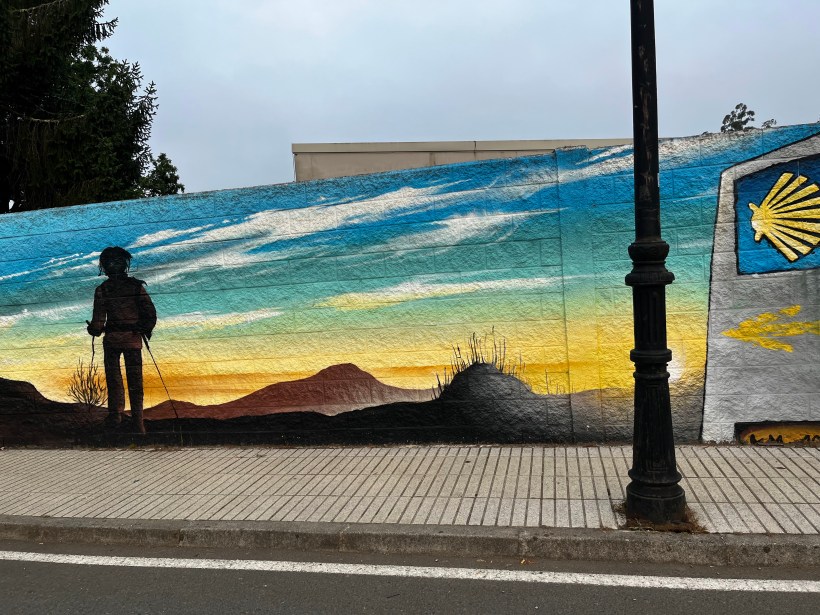
ONE YEAR AGO this week, I found myself lost and alone on a narrow street in Melide, Spain, with a dead cellphone battery, a desperate need to find a public restroom, and no sign of my travel companion. The realization I was off-course dawned vaguely, but more vivid and panic-producing was the awareness I was abandoned. In the vulnerability of that moment, my extensive experience as a solo traveler evaporated, replaced by formulas given to me by others, namely a long-ago abusive partner who often walked off when I failed to find our way quickly. Now churning in my stomach with unexpected acids of self-doubt, fear, and self-blaming was the Pulpo a la Gallega—octopus—offered for free by a street vendor and consumed just before a wrong turn. Traumas once long-gone bubbled up, tightening my chest, arresting my breath and finally erupting as hot tears of anger, hurt and confusion. I backtracked a few blocks, began to cross a four-lane street, but then froze in the pedestrian median, a pathetic middle-aged woman in a beautiful new country isolated in the desert of memory.

Continue reading “Walk Alone & See”

Facing enemies with detachment takes courage

I was prepared for battle, but like Queen Esther, I knew only God could give me the words to turn the heart of this rival. So I prayed.

By Jean P. Kelly

AS ADVISED BY the head of human resources, the phone number of the security department was cued on my phone in the event my employee again refused to leave my office during a performance meeting. She was once a close friend, but now as her supervisor, I needed armor for every encounter. On my desk, hidden in a folder, were a prepared and practiced script along with reminders of tactics. Don’t defend yourself; ask neutral questions; don’t get emotional even if she does; don’t accept unsupported claims meant to confuse you; keep focused on the agenda rather than reacting to petty grievances dredged from the past; breathe. Many years’ experience as a victim of narcissistic manipulation, usually leveraged to best effect by close family and friends, served me well as necessary fortification.

I learned the hard way how to confront enemies more formidable than those of Queen Esther in the Bible when she prayed “O God, whose power is over all, hear the voice of those in despair. Save us from the power of the wicked, and deliver me from my fear.” At least in mortal battles such as hers, tactics and wounds are more likely physical, overt and predictable than those of psychological warfare.

Continue reading “Facing enemies with detachment takes courage”

Make new friends without keeping the old

When friends drop us, even the pragmatic realization that all things have a season—even love—is cold company. But new friends will arrive, green leaves growing in our hearts.

By Jean P. Kelly

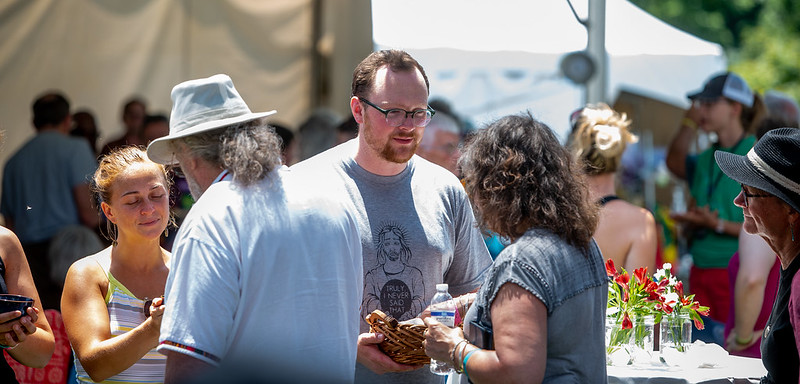
I WALKED FOR the first time into a multi-day ecumenical faith festival on my own, not knowing a soul and unsure what to expect as a newcomer. Within 15 minutes of arriving, I met a fellow podcaster, then her son, then her brother and by the end of the day I was part of their friends & family group enjoying a musician on stage. Throughout the next three days all were reliable companions, bearing out what I had heard about the authentic hospitality offered annually at the Wild Goose Festival. As one veteran attendee told me “I always make friends I don’t even know I need.”

Just a few days before I drove six hours to North Carolina, a friend of more than 30 years ghosted my invitation to dinner. A voicemail left for another long-time buddy during my return drive likewise went unanswered. That neither was an anomaly, yet I persisted in my attempts to connect, was all the proof needed to affirm how much easier it is to preach detachment than to practice it. My talk at the festival about the importance of establishing boundaries with loved ones, based on my book, Less Helping Them, More Healing You, concluded with a quote from a favorite spiritual teacher, Fr. Anthony DeMello: “When I die to the need for people, then I am right in the desert…. It is solitude, it is aloneness, and the desert begins to flower.”

Continue reading “Make new friends without keeping the old”